As the industry begins shaping 6G, Wi-Fi needs to be considered as part of the future connectivity framework from the beginning, not added later.
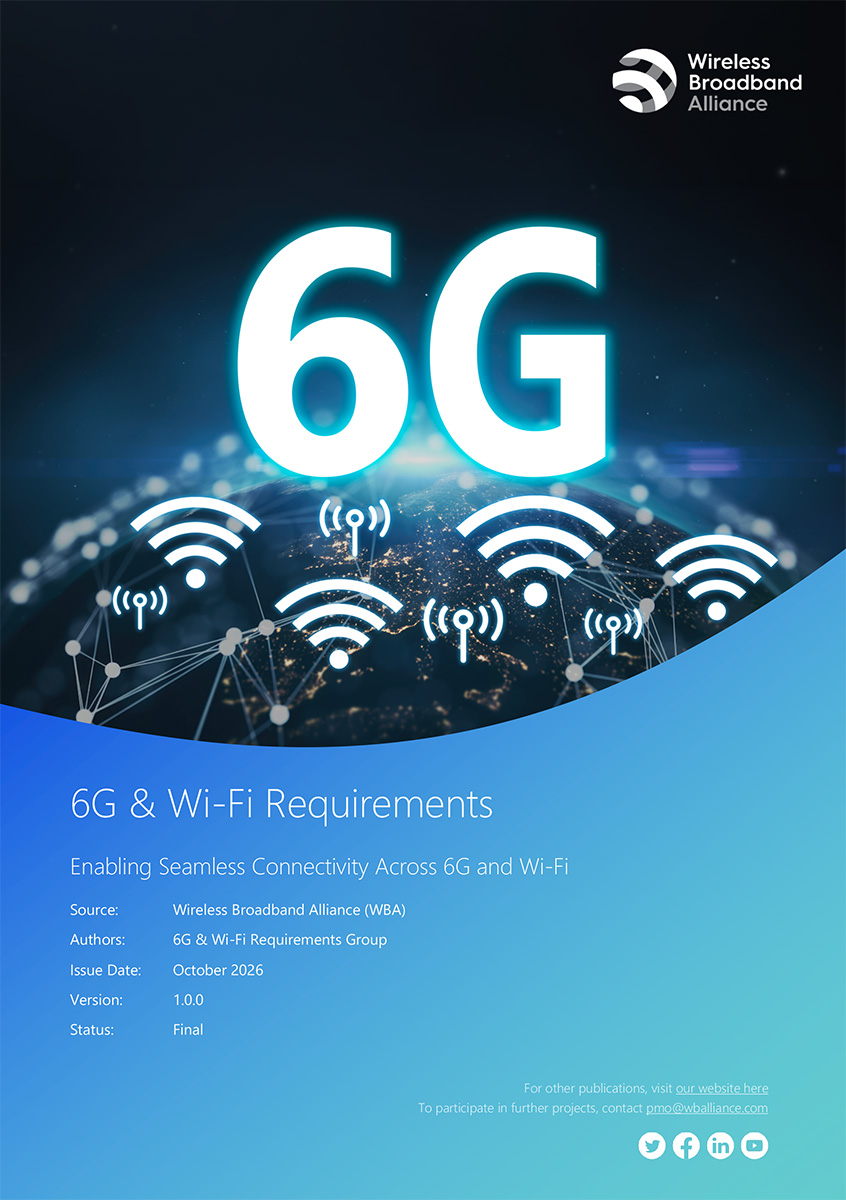
This 6G & Wi-Fi Requirements report includes certain business and technical requirements to help deliver more seamless connectivity across Wi-Fi and future cellular networks. It also examines the lessons from previous convergence efforts, sets out WBA’s vision for a more flexible approach and defines critical requirements to help guide future architecture and standards development.
Wi-Fi is essential to delivering the 6G vision, and should be considered in the design of the connectivity framework from the beginning. To be successful, future convergence should consider different network ownership and deployment models, rather than relying on a single cellular-centric architecture.
A few examples of the technical areas covered in the requirements include multi-vendor interoperability, authentication and authorization, simpler signaling and enhanced security, AI-enabled network recommendations, QoS-aware traffic steering and switching, user-centric mobility, energy efficiency and sensing.
What Wi-Fi and 6G Convergence Could Enable
A more effective approach to Wi-Fi and 6G convergence could help enable:
- Lower network costs through simplification, consolidation and better use of existing infrastructure
- Better customer experience through more seamless mobility, improved indoor coverage and consistent QoS
- Greater automation and lower operational complexity through AI-enabled network selection, resource management and improved visibility across networks
- New commercial opportunities including traffic offload, federated access, commercial partnerships and SLA-based services across mobile, fixed and Wi-Fi networks
- New service opportunities across industrial automation, smart cities, connected vehicles, intelligent transport, mission-critical communications and sensing
Who Could Benefit
These outcomes could create value across the connectivity ecosystem:
- Operators: better use of network capacity, simpler management and new commercial models.
- Device manufacturers: greater interoperability and more consistent authentication, mobility and network selection.
- Enterprises: simpler and more cost-efficient network environments.
- Consumers: more reliable connectivity and a more consistent experience across Wi-Fi and cellular networks.
What comes next
The requirements provide a benchmark for the next phase of WBA’s work, including evaluating emerging 6G convergence proposals, identifying architectural gaps and engaging with standards organizations as future 6G architectures develop.
WBA invites operators, vendors, device makers, enterprises and standards bodies to take part and help turn these requirements into deployable solutions, technical evaluations and future trials.
Download the report and help shape the next phase of 6G and Wi-Fi convergence.
Organizations interested in contributing use cases and insights are encouraged to engage with the WBA Program Management Office (PMO) with this form
This report is brought to you by: 5G / 6G Work Group.
To participate and learn more about WBA coming projects, contact WBA PMO.
Key Participants