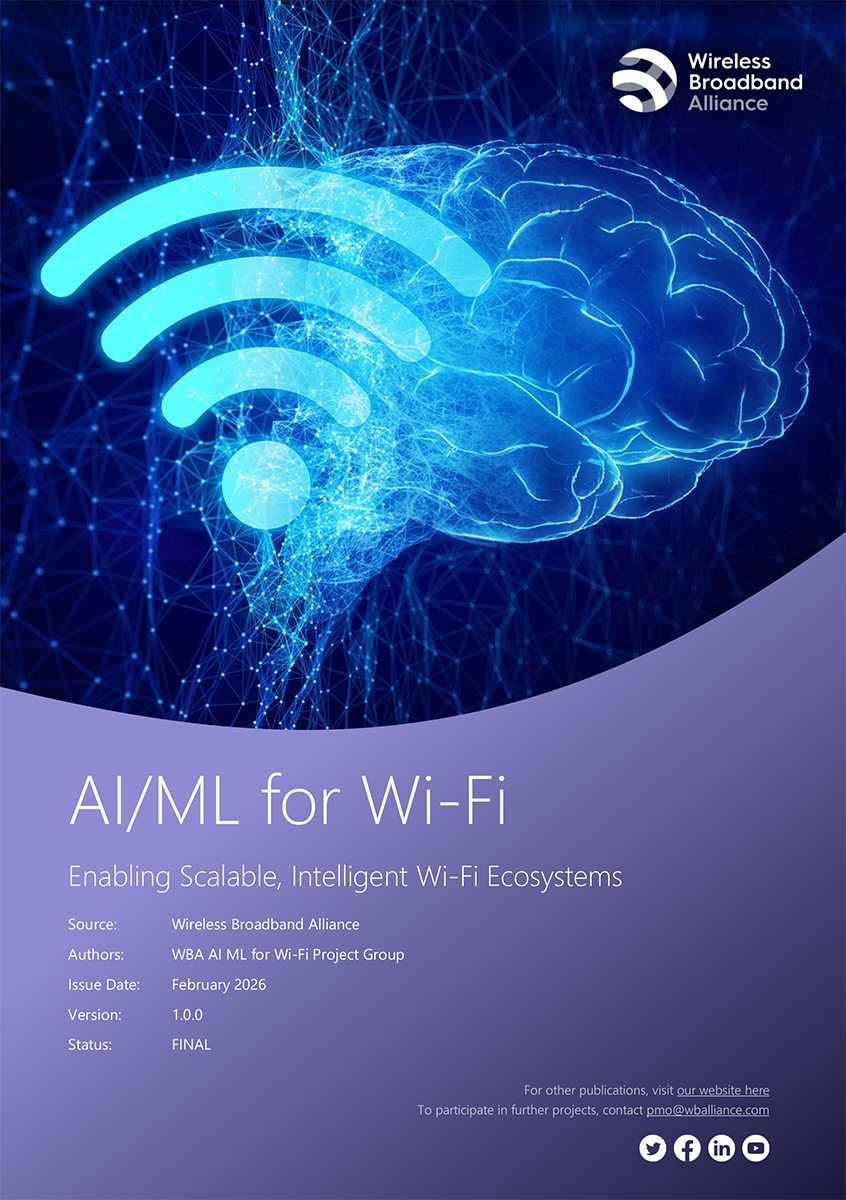
As Wi-Fi networks become more complex and mission-critical, traditional rule-based management approaches are no longer sufficient for network operations. Artificial intelligence and machine learning (AI/ML) are emerging as essential capabilities to deliver reliable, secure, and high-performance Wi-Fi at scale.
The AI/ML for Wi-Fi report provides an industry-wide view of how AI/ML enables a shift from reactive troubleshooting to predictive, proactive and self-optimizing network operations. The report outlines clear business benefits including lower operational costs, stronger reliability and security, and an improved end user experience..
As Wi Fi technology grows more complex and becomes mission critical — supporting increasingly demanding applications such as enterprise collaboration, industrial automation, immersive media, and AI workloads — traditional rule based management approaches are no longer adequate.
The report provides an industry-wide perspective for device manufacturers, network operators, enterprise IT and policymakers, on how AI/ML are being integrated across the full Wi-Fi ecosystem.
Key Takeaways from the Report
- AI/ML is becoming foundational to Wi-Fi. It is critical for enabling autonomous, self-optimizing networks capable of managing dense deployments and real-time performance demands
- Intelligent Wi-Fi has clear business value. AI/ML reduces operational costs (OpEx), improves reliability and security and delivers a more consistent quality of experience (QoE)
- Fragmentation remains a major barrier. Proprietary approaches, inconsistent data quality and closed interfaces slow innovation and increase integration costs
- Standardization should focus on frameworks. Interoperable frameworks, not algorithms, will be key to success. That interoperability will need to include data models, telemetry, APIs and model lifecycle management
- Hybrid AI architectures will dominate. AI will not just sit at the router, it will combine client, access point, edge and cloud intelligence to achieve the best performance
- AI/ML-native Wi-Fi is the long-term direction. Features of Wi-Fi 8 (IEEE 802.11bn), such DBE and MAPC, will work optimally when driven by an AI/ML engine
- Data is the primary bottleneck. Achieving continued success and new use cases with AI/ML in networks requires shared datasets, federated learning and strong governance models
Looking Ahead
Phase 2 will expand on these findings, proposing solutions that address identified opportunities and executing POCs with partners such as residential operators. Additional priorities include establishing standardization frameworks, enabling data sharing and anonymization, promoting open-source interoperability, defining AI/ML benchmarking and certification, and addressing trust, governance, and policy requirements.
Interested in Joining?
For current WBA Members:
Register your interest in the next trial phase: https://wballiance.com/engage-with-wba/
For organizations not yet part of WBA:
Contact WBA Membership at membership@wballiance.com to learn how to join and participate in upcoming programs.
Download other publications, visit the WBA Resource Centre.
This whitepaper is brought to you by: WBA Next Gen Work Group.
To participate and learn more about WBA coming projects, contact WBA PMO.
Key Participants:




Editorial Team:







Project Participants: