
-Luke Kehoe, Ookla Analyst
The world’s best voice networks are built on mature, optimized VoLTE footprints. VoNR superiority is implementation-dependent, not inherent.
Voice remains the universal baseline service that consumers, enterprises, and regulators implicitly assume will “just work.” While consumers increasingly rely on over-the-top messaging and video calls, traditional circuit-switched or packet-switched voice calls still account for a significant portion of network usage by time and operator revenue. Voice performance is also a key driver of customer satisfaction and churn, with poor call setup times or inconsistent experiences directly eroding trust in the network.
As 5G standalone (SA) deployments accelerate globally, a fundamental question emerges for operators and subscribers alike: does Voice over New Radio (VoNR) actually deliver a more responsive calling experience than its 4G predecessor (Voice over LTE, VoLTE)?
This analysis draws on extensive controlled testing data collected across eight diverse global markets by RootMetrics (known as Speedtest DriveTM in some markets): Seoul (South Korea), London (UK), Malaysia (nationwide), New York (US), Singapore (nationwide), Lisbon (Portugal), and Luanda (Angola) in 2H 2025, as well as Manila (Philippines) in 1H 2026.
Key Takeaways:
- VoLTE remains the gold standard for consistency and speed in mature deployments. Korean operators in Seoul lead with a 1.06-second median call setup time on VoLTE, faster than any studied VoNR deployment globally, with over 90% of calls meeting a two-second setup target. This reflects years of refinement in IMS core and radio parameters.
- VoNR shows promise but uneven maturity. Across eight operators, only six connected calls faster on VoNR than VoLTE. Median setup times are often strong, but the slowest 5% of VoNR calls can lag well behind VoLTE for some operators. These tail cases matter because users experience outliers, not averages, and they point to issues such as coverage gaps, paging delays, or inter-RAT transitions that medians can hide.
- Where VoNR is optimized, it delivers material gains. Singtel posts a 1.07-second VoNR median, outperforming its own VoLTE layer and most comparable networks outside Korea. In Malaysia, YES achieves a 1.6-second VoNR median, over half a second faster than its VoLTE. These results suggest both operators have optimized their 5G cores to eliminate the legacy signaling issues that can hinder older IMS deployments.
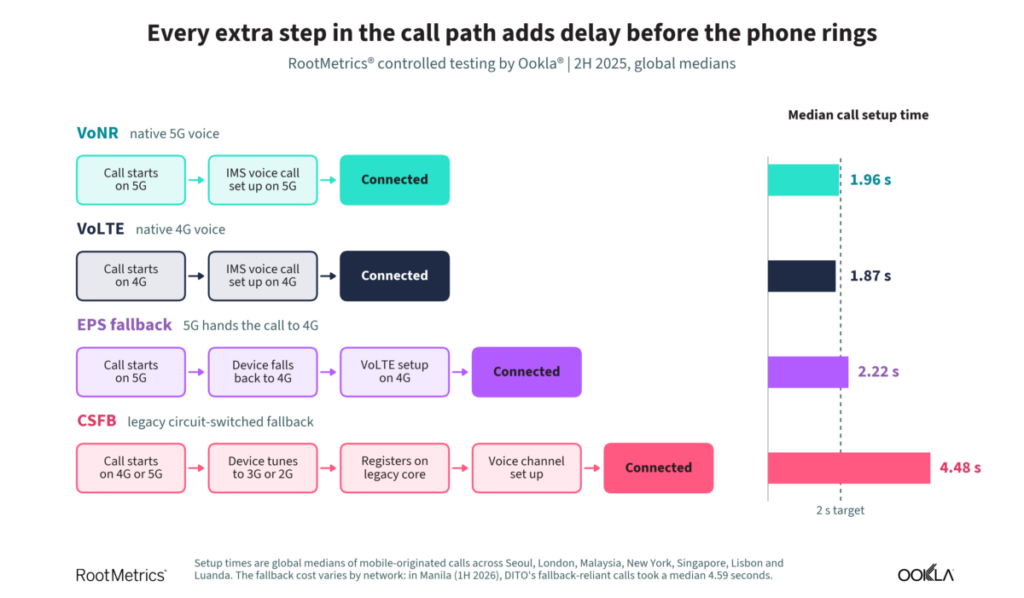
- The legacy “fallback penalty” is real. Without VoNR or VoLTE, or during coverage gaps, devices must fall back from 5G to 4G using evolved packet system (EPS) fallback or even 3G using circuit-switched fallback (CSFB). Globally, CSFB fares far worse, with a median setup time of 4.48 seconds (2.4× slower than VoLTE) and 5.5% of calls exceeding 10 seconds, a failure mode still dominant in markets such as Luanda (Angola).
- The 2-second threshold matters because users experience sub-2-second call setup as effectively instant. It also exposes sharp operator gaps. EE and Three UK, with VoLTE medians around 1.4 seconds, complete over 93% of calls within 2 seconds. Operators closer to 2.3 seconds, including Vodafone UK, AT&T and T-Mobile U.S., cluster near 30–35%. In developed Asia, the spread is wider still, from SK Telecom at 98.5% to M1 Singapore at just 0.1%.
Call setup time is a critical first impression of network quality
Voice remains the primary real-time application on mobile networks. In a market increasingly shaped by data-led narratives, call setup time is one of the few key performance indicators (KPI) that still captures something visceral about the mobile experience: how quickly the network turns intent into outcome, from pressing call to hearing ringback. Psychologically, a setup delay under 2 seconds feels instant. Delays exceeding 4 to 5 seconds trigger user anxiety and uncertainty about whether the call has failed.
Research has consistently shown that delays beyond 2 seconds begin to feel noticeable, contributing to frustration. This finding informs quality of service guidance from standards bodies like the ETSI, which place call setup time objectives below 2 seconds for “fast connect” experiences. For this reason, as part of this study, we examine attainment against the gold standard 2-second target, noting that the perceived importance of network quality correlates strongly with markets exhibiting low churn risk in parallel consumer surveys.
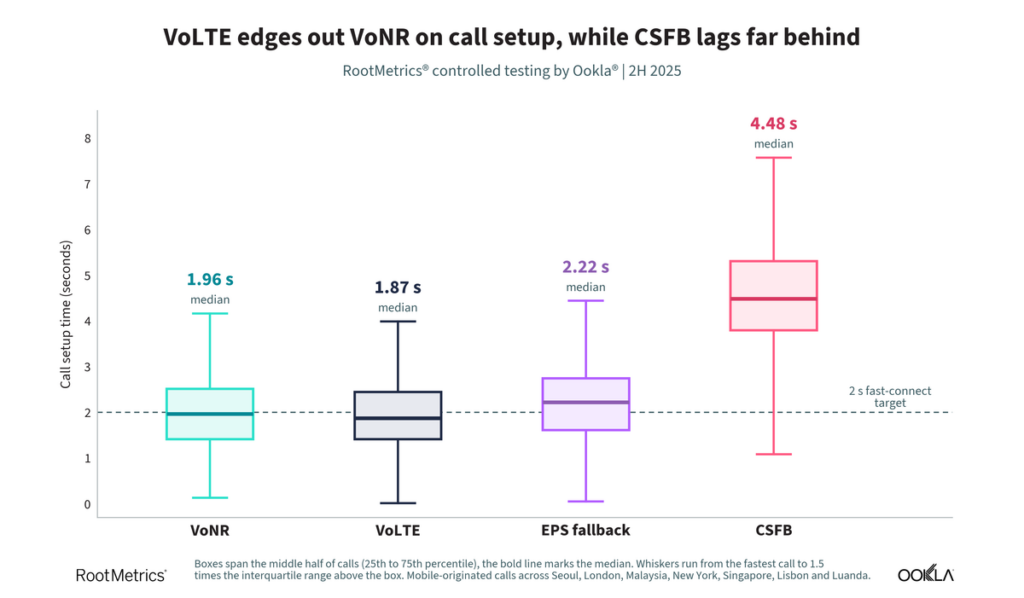
In addition to absolute performance, variance or consistency in setup times also matters. A low median time is meaningless if variance is high. An operator delivering consistent 1.8-second connections provides a more predictable experience than one oscillating between 0.5 and 8 seconds, even if their averages are similar.
Call setup time distributions are usually skewed. Most calls connect quickly, but a small minority take much longer. Those delays typically come from paging cycles, when the network is locating the device, radio state transitions from idle to connected, when the radio wakes from low-power mode, IMS registration behavior, when the device connects to the multimedia core, congestion, or inter-RAT procedures, when the device switches between network generations, such as a handoff from 4G to 3G.
This is important commercially. Voice remains a highly salient service, and metrics such as dropped call rates and call setup consistency translate directly into perceived network quality. Empirical literature links poor voice outcomes to increased churn, and Verizon’s long running “Can you hear me now?” campaign in the U.S. illustrates why voice reliability is one of the few network attributes that is instantly understood by consumers and can meaningfully shape brand preference.
VoNR deployment often lags 5G SA commercialization for good reason
As networks evolve toward a new 5G core architecture (the central system that manages all network functions), operators’ 5G SA deployment decisions are increasingly being made with VoNR in mind. Commercializing VoNR and native 5G voice requires launching the SA core and control plane (the network layer that manages call setup and signaling) as a prerequisite.
However, many operators who deployed 5G SA early chose to prioritize “SA for data” first for capacity, latency, and slicing readiness while keeping VoLTE as the voice anchor on a low-band, FDD (frequency division duplex) coverage layer. This works nicely from a network design perspective since voice does not require significant spectral capacity, and also performs best with the contiguous coverage that lower frequencies provide deep indoors and in rural areas.
Most operators use EPS fallback (shifting from 5G back to 4G to complete a call) as a risk-managed bridge where the SA footprint or operational maturity is incomplete. This decision makes commercial sense because the business case for VoNR is uneven and context-dependent.

VoNR’s user-visible upside is often marginal until SA coverage is sufficiently ubiquitous (requiring dedicating low-band spectrum capacity to SA), device/tariff penetration is high, and IMS voice (the system enabling voice calls over data networks) is hardened across mobility, inter-RAT handovers (switching between different network types like 5G and 4G), emergency calling, and roaming.
The operators that move fastest on VoNR tend to be engaging in a greenfield network buildout. An example includes Echostar’s Boost Mobile network in the US prior to its wind down. Laggard operators often rationally defer VoNR launch until SA delivers a measurable differential and the failure modes are commercially acceptable. These failure modes include setup variance, drops at cell edges, and interoperability issues.
The theoretical advantages of VoNR are material and should yield faster, more consistent setup times than VoLTE. In theory, VoNR offers operators a path to a simpler, more efficient voice stack by keeping calls entirely on 5G SA, avoiding EPS fallback and reducing inter-RAT complexity that can inflate setup times and variability.
In practice, VoNR is intended to improve perceived responsiveness through faster, more consistent call setup. It sustains better voice quality through EVS (Enhanced Voice Services, an advanced audio format) and tighter QoS control (the network’s ability to prioritize certain traffic). It can also deliver more stable performance under load because voice is scheduled and prioritized natively within the 5G framework.
Strategically, VoNR supports long-term network economics by accelerating the retirement of legacy voice dependencies, freeing 4G capacity, and converging voice and data on a single core with clearer policy control and analytics.
VoNR vs. VoLTE: Optimization trumps technology generation
Despite VoNR’s theoretical advantages, the reality as measured across our dataset proves considerably more nuanced. Globally, VoNR delivers a median setup time of 1.96 seconds compared with VoLTE’s 1.87 seconds. The roughly 5% gap at the median is small enough to be considered comparable within the limits of this study, and VoLTE exhibits a modestly higher share of samples meeting the 2-second setup target. The more meaningful divergence emerges in the distribution tails and in the variance between operators, where deployment maturity rather than technology generation likely explains the performance spread.
VoLTE has benefited from a decade of global refinement and tuning. This includes optimized SIP signaling (the protocol that initiates and manages voice calls), dedicated QoS bearers (reserved data channels that guarantee consistent call quality), and robust SRVCC handovers (Single Radio Voice Call Continuity, which seamlessly transfers calls to older networks when needed).
Indeed, the two Korean operators in Seoul, LG U+ (median 0.73 seconds) and SK Telecom (median 0.99 seconds), offer the fastest call setup times globally, as well as tight variance and near-universal 2-second compliance, on VoLTE. LG U+’s global lead is particularly striking, with a median setup time that is more than 25% and 32% faster than the second and third-best performing operators globally.
Outside of Asia, both EE (median 1.37) and Three (median 1.41) in London also offer some of the fastest call setup times globally, and do so on VoLTE. The UK’s VoLTE penetration stands at roughly 93% of connections (GSMA Intelligence, 2025), providing operators with a deep, well-established base upon which to optimize. Portugal’s MEO (median 1.67) also ranks favorably among global VoLTE leaders.
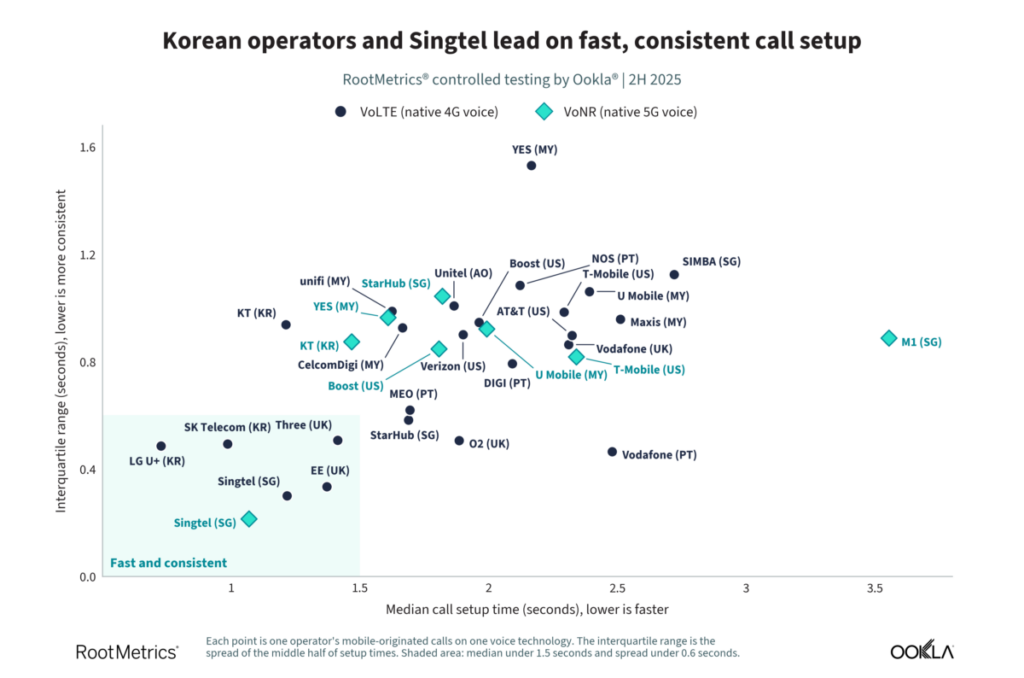
These strong VoLTE results demonstrate that mature deployments of the 4G-based voice stack remain highly competitive. They also show that optimization has provided a significant runway for continued VoLTE competitiveness even as VoNR scales.
VoNR outcomes diverge by deployment and optimization maturity
Among operators with meaningful volumes of both VoNR and VoLTE, VoNR outcomes cluster into two distinct maturity profiles. The cautionary cases warrant attention and reflect instances where operators appear to have deployed VoNR without achieving the optimization necessary to surpass their mature VoLTE services.
Both Singapore’s Starhub and Korea’s KT, for example, feature VoNR setup times that trail their respective VoLTE outcomes, with performance 32% and 13% slower respectively. Specifically for Starhub, while its 1.82 second median on VoNR looks very respectable, the 95th percentile balloons to 6.33 seconds, and only 57% of VoNR samples met the 2 second target. This compares unfavorably with the materially stronger performance on its VoLTE, where nearly 80% of samples meet the 2 second target and the 95th percentile remains low at 2.38 seconds.
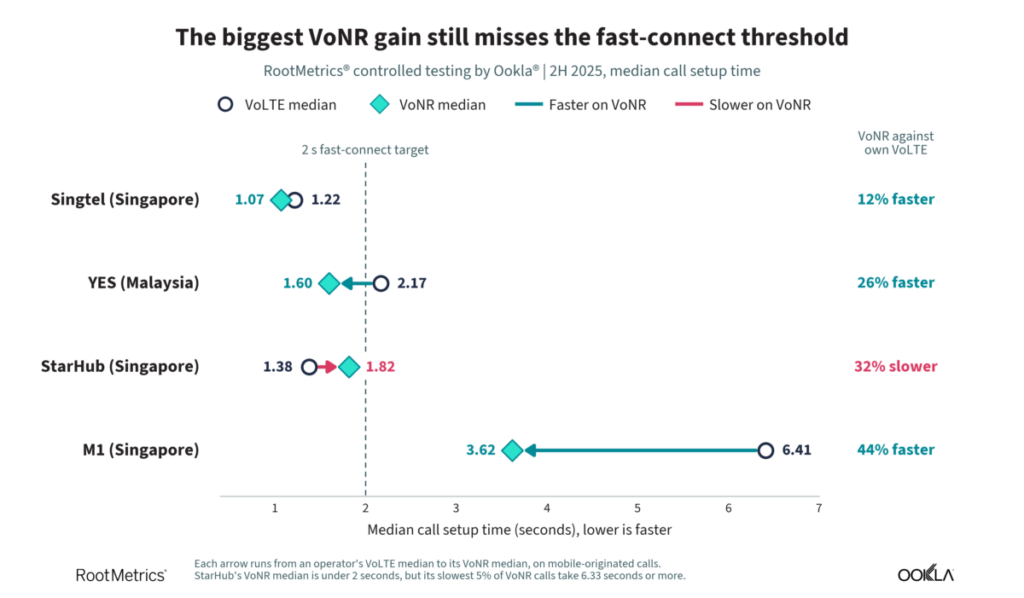
Similarly, while nearly three in four samples were based on VoNR on M1’s network in Singapore, and its VoNR features a 43.5% improvement in setup times (median 3.62 seconds), this reflects the exceptionally poor performance of its VoLTE (6.41 second median) in testing rather than VoNR excellence. Its VoNR footprint also exhibited extreme tails in testing, with high variance potentially indicative of suboptimal policy rules, incomplete coverage, or signaling bottlenecks.
In contrast to these less mature VoNR deployments, there are notable examples of operators with standout successes that already prove the potential.
Singtel’s VoNR (median 1.07 seconds) in Singapore delivers median setup times below most regional VoLTE deployments including its own (median 1.22 seconds), with tight variance and over 90% compliance with the 2-second target. This VoNR performance ranks in the top three globally for any voice technology across the studied operators and is the fastest outside of Korea.
Malaysia’s YES also delivers strong VoNR performance. Median VoNR call setup time on YES (1.6 seconds) was around 26% faster than its VoLTE baseline (2.17 seconds), and ranked as the third-fastest VoNR result among tested operators globally, behind only Singapore’s Singtel and South Korea’s KT.
This is notable because Malaysia’s measurements span the entire country in our testing, which typically introduces more variability from rural coverage along highways. While VoNR deployment is concentrated in urban areas, the VoLTE results still reveal whether voice services are effectively distributed nationwide and whether local infrastructure (such as regionally positioned IMS/core resources) supports fast call setup across diverse geographies. Malaysia’s VoLTE penetration has risen sharply, reaching an estimated 92% of mobile connections by 2025 according to GSMA Intelligence, providing a mature VoLTE substrate that underpins these results.
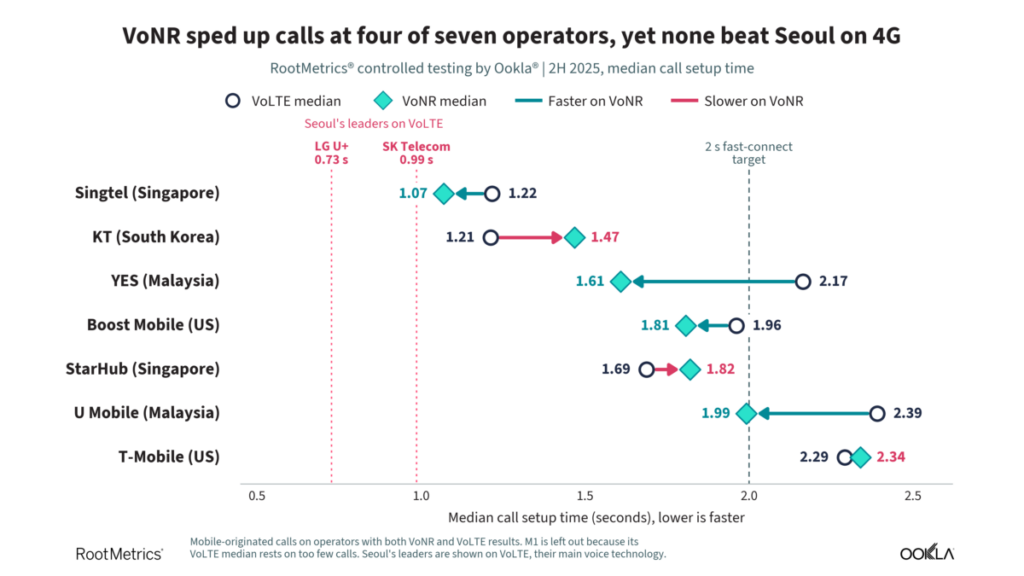
In the U.S, Boost Mobile, delivered notably strong VoNR performance in New York (median 1.81 seconds), significantly ahead of T-Mobile (median 2.34 seconds), the other U.S. operator that has led VoNR commercialization. Boost Mobile leveraged the greenfield, open RAN-based 5G SA network deployed by DISH Network and its parent company Echostar, which abandoned further rollout plans last year.
Insights from the Philippines: a market in transition
A separate 1H 2026 controlled drive test in Manila provides a window into call setup performance in a market at a much earlier stage of its voice technology evolution. The Philippines had only an estimated 31% VoLTE penetration as a share of mobile connections in 2025 (GSMA Intelligence), roughly a third of the level in South Korea or Singapore, though this figure has been rising quickly from just 14% in 2023 and is forecast to exceed 43% in 2026. Three operators were tested: Globe Telecom, Smart (PLDT), and DITO Telecommunity.
Globe Telecom delivered the fastest median call setup time in the market at 1.65 seconds, with a 95th percentile of 2.86 seconds, placing it comfortably within the range of well-optimized VoLTE operators globally. Globe’s voice traffic ran almost entirely on VoLTE (99.85% of originating samples), and its median performance compares favorably with established operators in more mature markets such as Portugal’s MEO (1.67 seconds).
Smart, PLDT’s mobile brand, posted a 2.30-second median with a far heavier tail: a 95th percentile of 7.23 seconds, more than three times its median. Smart’s voice traffic was also predominantly VoLTE (99.94%), but that long tail suggests room for further signaling and paging optimization.
DITO presents a notably different profile. As the Philippines’ third mobile operator and the only one operating a 5G SA core network built from the ground up, DITO’s voice architecture relies heavily on EPS fallback. Roughly 89% of its originating voice samples fell back from 5G to 4G to complete calls, with only 11% handled natively on VoLTE.
This is a direct consequence of DITO’s SA-first network design: devices camped on DITO’s NR SA layer must execute EPS fallback to reach the VoLTE service anchored on its 4G infrastructure, as DITO has not yet commercialized VoNR. The result is a 4.59-second median call setup time, with a 95th percentile of 5.99 seconds.
Moving away from legacy voice architectures can yield major gains
CSFB, whereby devices connected to 4G drop back to 2G or 3G networks to complete voice calls, represents a transitional technology that has persisted far longer than originally expected. In markets where VoLTE coverage remains incomplete or where legacy device populations remain significant, CSFB continues handling substantial voice traffic and plays an important role as an “insurance policy” in ensuring access to emergency calling (or inbound roaming on older devices in some countries).
The performance penalty of reverting to CSFB, however, is stark. In our testing, CSFB delivers a median call setup time of 4.48 seconds, more than twice as slow as VoLTE’s (1.87 seconds). The 95th percentile reaches 10.75 seconds, meaning 1 in 20 CSFB calls takes significantly longer than most subscribers would consider acceptable. Perhaps most strikingly, 5.5% of CSFB calls exceed 10 seconds, a rate that is 11 times higher than VoLTE (0.49%).
While at least some of this penalty is likely skewed by the fact that CSFB is only activated in advanced networks at the extreme cell edge where 4G or 5G is unavailable and overall signal conditions are poor, the underlying weakness is CSFB’s inherent complexity. When a user initiates a call, the device must receive a fallback command from the 4G/5G network, tune to 2G/3G frequencies, complete registration with the circuit-switched core, establish the voice bearer, and then signal call setup. Each step introduces latency that native VoLTE or VoNR architectures avoid.
Luanda illustrates the consequences of CSFB dependency. Africell, operating on CSFB, delivers a 4.97 second median setup time in our testing and achieves 0% compliance with the 2-second target. Unitel Angola, having deployed VoLTE, achieves 55% compliance with 2.49 second median, still lagging developed markets but demonstrably superior to its CSFB competitor. Angola’s VoLTE penetration remains among the lowest of any market in our study at roughly 24% of connections (GSMA Intelligence, 2024), underscoring how early-stage VoLTE adoption constrains voice quality outcomes at a market level.
No-one-size-fits-all voice journey for every operator
Voice may represent a mature service, but call setup performance remains a differentiator. In an era of data-centric network investment, these findings suggest voice quality optimization continues to merit strategic attention. The performance spread between operators in the same market can be significant. This is not simply explained by the adoption of modern technologies like VoNR, but by years of investment in careful optimization to surgically improve outcomes.
Seoul demonstrates that world-class voice quality is achievable without extensive VoNR deployment. Operators with limited 5G SA coverage, especially in lower bands, may achieve better near-term returns by optimizing VoLTE rather than rushing VoNR to market. Where VoNR is optimized, as with Singtel in Singapore, it demonstrates real promise. The better observed variance compared to VoLTE can positively affect perceived quality independently of median performance.
The case for operators maintaining significant CSFB traffic is weak outside of last resort scenarios. The performance gap between CSFB and all-IP voice solutions is large enough to affect competitive positioning. Accelerating VoLTE coverage expansion and legacy network retirement should be a priority.
Measuring voice quality in the AI era will need to go beyond the bearer
The benchmarking framework explored in this analysis, centered on call setup time, consistency, and technology path, reflects the established HD Voice paradigm. This paradigm treats voice performance as a function of three interlocking factors: coverage, quality of service, and quality of experience.
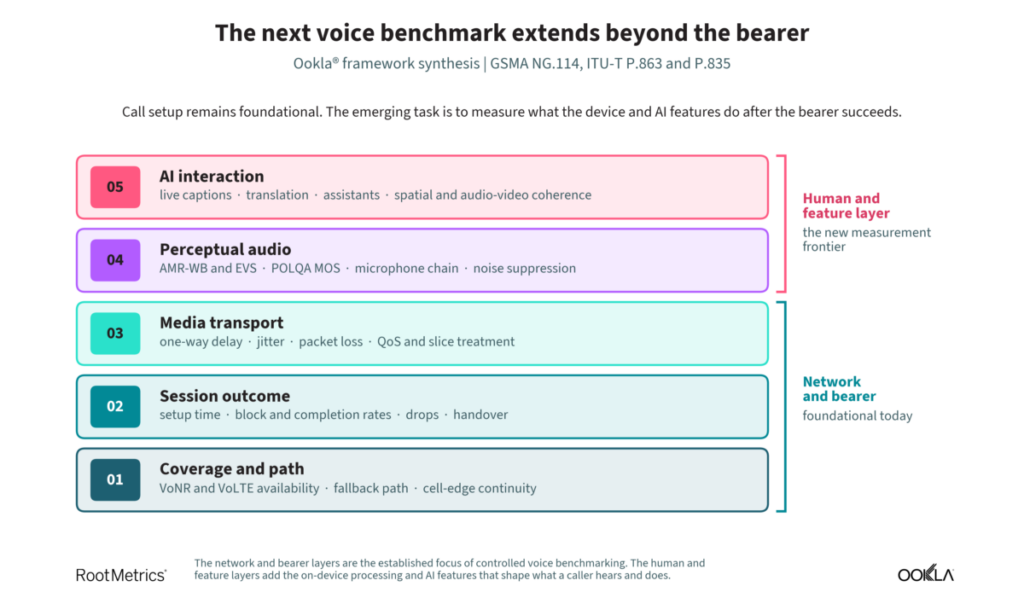
Coverage means whether users are consistently served by VoLTE or VoNR, rather than falling back to legacy technologies. Quality of service covers call setup and completion, drop rates, and the latency, jitter, and packet-loss limits needed to sustain a stable bearer. Quality of experience is what users actually perceive, where codec capability is the primary lever, from AMR-WB wideband to EVS super-wideband and fullband audio. These three dimensions have served operators and benchmarking bodies well for a decade.
As voice becomes AI-enhanced, however, that framework will need to expand. Real-time speech enhancement and noise suppression, spatial audio, and voice-video coherence are already shipping in flagship devices and operator-branded calling features. These add an immersive dimension to perceived quality.
Existing MOS-based measurement, such as ITU-T P.863/POLQA for speech and P.835 for noise suppression, can quantify some of this. But traditional drive testing rarely captures it. This is partly because reference audio is usually injected into test devices electrically, rather than picked up acoustically through their microphones. This bypasses the electro-acoustic chain where much of the on-device processing actually operates.
Simultaneously, AI-powered live captions, real-time translation, and conversational assistants are introducing an interaction dimension that blurs the boundary between the network bearer and the application layer. Benchmarking voice in this evolving landscape will increasingly require measuring OTT, including how slice-based prioritization treats communications apps, and feature-layer outcomes alongside the underlying IMS bearer, even as the latency discipline and QoS guarantees explored throughout this analysis remain foundational to conversational quality.
Ookla® evaluates network experience through two complementary methodologies: controlled benchmarking, in which trained teams drive predefined routes with identical devices and test scripts, and crowdsourced data from tens of millions of real-world consumer devices via Speedtest Intelligence®. The controlled results in this analysis were collected using Ookla’s RootMetrics® testing product, referenced as Speedtest Drive™ in some markets. Controlled testing isolates network behavior, such as call setup signaling, under repeatable like-for-like conditions that crowdsourcing cannot guarantee.