Resources Centre
CATEGORIES


Wi-Fi 6 Trial Report – Industrial Manufacturing
Mettis Aerospace worked with Broadcom, Cisco, iBwave and Intel to deploy Wi-Fi 6 in a dense industrial environment with heavy metal, high temperatures and moving machinery, where previous generations of Wi-Fi did not perform well. The Wi-Fi 6 trial demonstrated much improved reliability, coverage, throughput and lower latency for supporting mission critical applications.
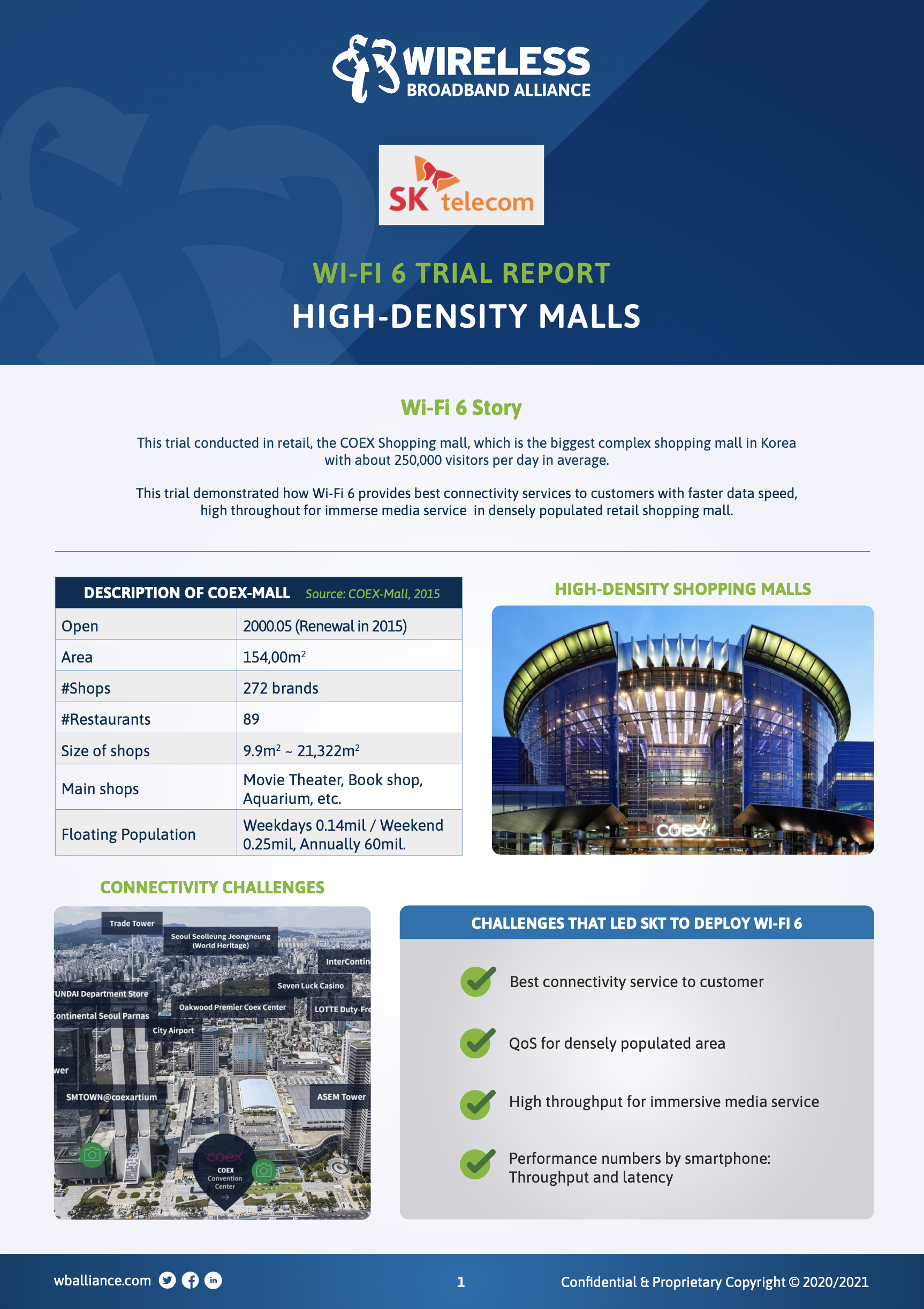
Wi-Fi 6 Trial Report – High-density malls
SK Telecom deployed Wi-Fi 6 to improve connectivity for consumers, increase quality of experience (QoE) for densely populated areas and provide high throughput for immersive media services. Wi-Fi 6 reduced latency by 80 percent, reduced throughput fluctuation, and improved service reliability to customers anywhere, anytime, throughout the mall.
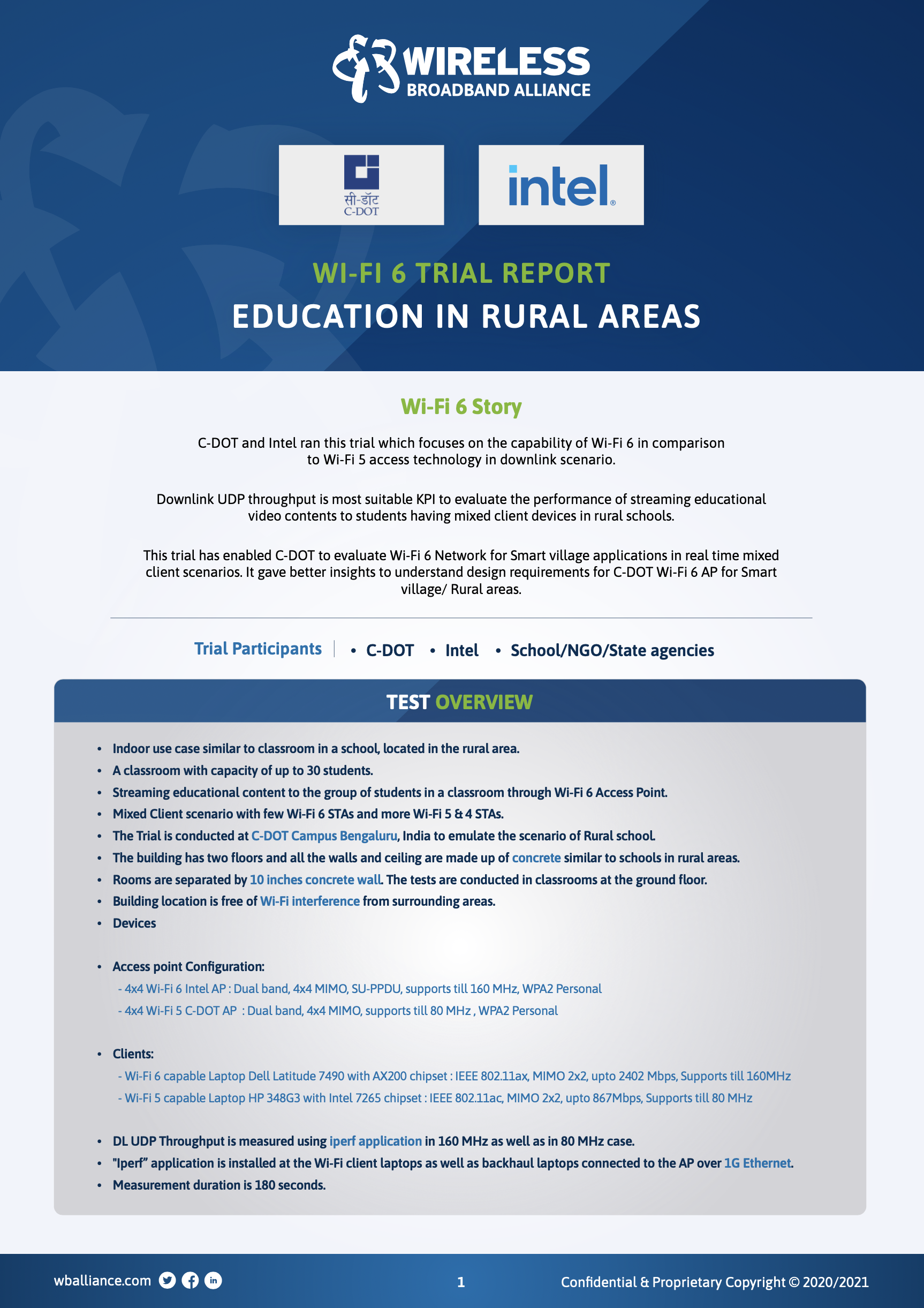
Wi-Fi 6 Trial Report – Education in rural areas
C-DOT and Intel deployed Wi-Fi 6 in a rural school trial in India to enhance new learning technologies, and improve signal coverage and streaming performance. Wi-Fi 6 improved throughput by more than 50 percent throughout the network.
Wi-Fi 6 Trials Report
WBA’s Wi-Fi 6 program aims to drive the adoption of Wi-Fi 6 and has previously released the Wi-Fi 6 Deployment Guidelines white paper, which outlines different vertical use cases and and provides guidance on best practices for deployments. WBA provides a platform for end-to-end Wi-Fi 6 trials based on a comprehensive test plan to demonstrate key Wi-Fi 6 capabilities in end-to-end real life networks and showcase the readiness for carrier Wi-Fi deployments across different geographies and various key verticals.

Wi-Fi Opportunities for Connected Vehicles
The connected and autonomous driving vehicles market is driving the evolution of the vehicular industry and is growing at an eight-year compound annual growth rate of 22.3%, i.e., 5 times faster than the overall car market. The business opportunity for connected vehicles is significant, with the global market expected to grow to over $212 billion by 2027.
WBA’s latest white paper, “Wi-Fi Opportunities for Connected Vehicles – Demand for Data and Multi-Access Edge Computing”, evaluates the data exchange requirements for enabling the various connected vehicle use cases, irrespective of the choice of the communication technology and the spectrum band to be used, re-enforcing the need for multi-access edge computing architectures for connected vehicles. The gaps and opportunities for Wi-Fi in such architectures are analyzed and the WBA’s potential role in addressing them is outlined.
PKI RadSec – Operator Deployment Guidelines
The growth in devices is being accompanied by continued growth in the number of Wi-Fi hotspots. Earlier work by the WBA has identified the use of RadSec, a protocol defined by the IETF in RFC 6614 for transporting RADIUS datagrams over TLS, coupled with a Public Key Infrastructure (PKI), for automating the security of these TLS sessions, as an alternative to the conventional WRIX approach.
With the growth of Wi-Fi interoperability and Wi-Fi roaming services, more service, network and identity providers are looking to build roaming businesses for which an easy and fast method to scale up interconnections is key.
RadSec certificate-based interconnection, through the WBA Public Key Infrastructure (PKI), provides a secure, simpler and less manual method to establish peer interconnection.
The document, “PKI RadSec – Operator Deployment Guidelines” provide guidelines for implementing RADIUS interconnections using RadSec coupled with WBA’s PKI. These guidelines will act as a roadmap that will help planners and systems engineers ensure that RadSec installations go smoothly and efficiently. Adherence to the practices defined will also allow for a more standardized configuration approach and allow for consistent interconnections. This work complements the already released “End-Entity Deployment Guidelines” document, which provides guidance for organizations with Wi-Fi footprint and/or subscribers who intend to deploy WBA’s interoperable Public Keying Infrastructure (PKI) RadSec security service.
The PKI-RadSec Documentation are fully accessible for WBA members only. If you are a WBA Member, please access the WBA Extranet to download PKI-RadSec Documentation, including the WBA PKI Certificate Policy, End-Entity Deployment Guidelines and PKI RadSec – Operator Deployment Guidelines.
The PKI RadSec – Operator Deployment Guidelines is brought to you by WBA Roaming Evolution group.
Please contact us to find out more about the full document available to WBA members.
PKI & RadSec End-Entity Deployment Guidelines
With the growth of Wi-Fi interoperability and Wi-Fi roaming services, more service, network and identity providers are looking to build roaming businesses for which an easy and fast method to scale up interconnections is key.
RadSec certificate-based interconnection, through the WBA Public Key Infrastructure (PKI), provides a secure, simpler and less manual method to establish peer interconnection.
This document, “PKI RadSec – End Entity Deployment Guidelines”, provides information and guidelines for organizations with Wi-Fi coverage and/or subscribers on how RadSec can help their interworking business. It also offers recommendations and guidelines on how to set up PKI RadSec. This work complements the already released “PKI RadSec – Operator Deployment Guidelines” document, which provide guidelines for implementing RADIUS interconnections using RadSec coupled with WBA’s PKI.
The PKI-RadSec Documentation are fully accessible for WBA members only. If you are a WBA Member, please access the WBA Extranet to download PKI-RadSec Documentation, including the WBA PKI Certificate Policy, End-Entity Deployment Guidelines and PKI RadSec – Operator Deployment Guidelines.
The PKI RadSec – End Entity Deployment Guidelines is brought to you by WBA Roaming Evolution group.
Please contact us to find out more about the full document available to WBA members.
WiFi Motion Intelligence: The Fundamentals
A Case Study by Telefónica, Quantenna, and Aerial Technologies
This document summarizes the pillars behind the technologies developed by Aerial Technologies and the result of the Precommercial pilot with Telefónica. The reader will be able to understand the sensing mechanism used by Aerial and how they leverage the existing WiFi infrastructure to perform device-free human activity classification and how this technology was used in the pilot with Telefónica.
In-Home Wi-Fi – Use Cases Public Executive Summary
The WBA recently outlined the recommended industry guidelines and best practices for operators to achieve high-quality In-Home Wi-Fi. With building construction and layout having a material impact on coverage of Wi-Fi within a home, it was identified that homes increasingly require Wi-Fi networks comprised of multiple access points. The complexity of delivery and management of these access points can ultimately impact performance and customer satisfaction.
In the latest stage of WBA’s In-Home Wi-Fi program, we are building on this previous report with the goal of extending it to define the standards that create the ultimate in-home Wi-Fi experience. The following executive summary provides an understanding of its scope, use cases, and path towards interoperability testing.
The In-Home Multi-AP Use Case Scope Document is brought to you by WBA Next Gen Work Group – In-Home Wi-Fi Project Team. Please contact us to find out more about the full document available to WBA members.
The Definitive Guide to Central Wi-Fi Authentication for Hotel Brands
Free, reliable Wi-Fi continues to be the #1 most desired amenity. Yet, hotel brands still continue to struggle with how to deliver a consistent, high performance experience when each of their properties has its own network hardware, software and service provider.
Central authentication allows brands to manage guest authentication and network performance from a simple web interface to deliver great guest Wi-Fi, always and everywhere. In this guide we’ll cover what central Wi-Fi authentication is and how hotel brands can leverage Wi-Fi to build loyalty.