Resources Centre
CATEGORIES

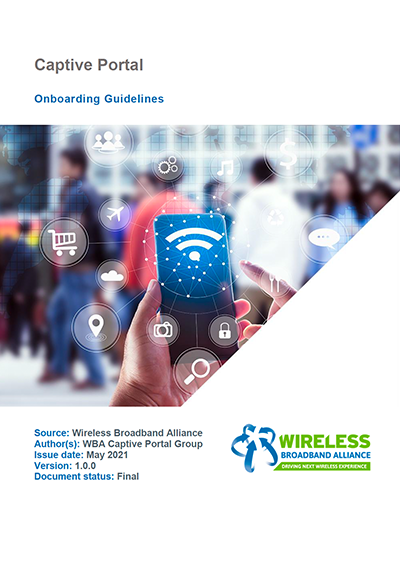
Captive Portal Onboarding Guidelines 2021
This Captive Portal Onboarding Evolution white paper provides industry-wide solutions and guidelines to identify captive portal design and deployment issues. Identifying the improvement and best practices helps increasing Wi-Fi usage and profits from providing Wi-Fi connectivity seamlessly and better data and security protection for users.

Wi-Fi Sensing – Test Methodology and Performance Metrics, 2024 Edition
In 2020, WBA launched a Wi-Fi Sensing Whitepaper providing an overview of Wi-Fi Sensing technology, classifying use cases and requirements, and identifying the gaps in Wi-Fi standards which would lead to the enhancement of the technology and ease of deployment if those gaps are addressed with Home Monitoring case study.
Wi-Fi Sensing is a relatively new technology with no current standard currently in existence. While some applications can be enabled using existing standards, there are technology gaps that limit the range of applications. Today, a number of products are available which are based on existing Wi-Fi standards, and the IEEE has recently formed a new task group, 802.11bf, that will focus on creating and improving existing standards specific to sensing applications. As this technology becomes more widely available, there is a great deal of interest within the industry looking towards evaluating and testing it. However, there is currently no standard methodology outlining how it should be validated, what tools to use, or what external factors impact the behavior.
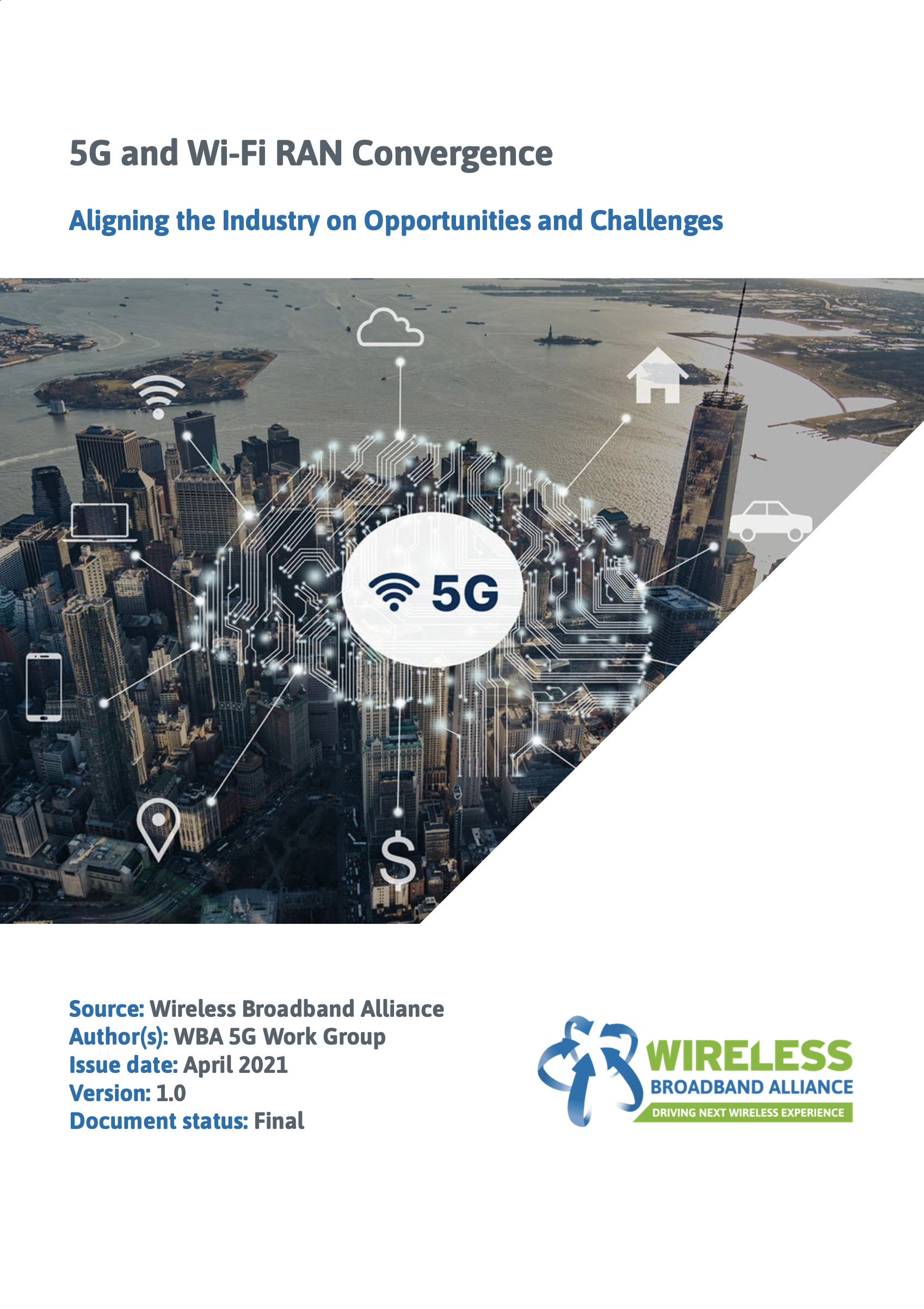
5G and Wi-Fi RAN Convergence
In 2019, the WBA and NGMN created a RAN Convergence White Paper to address some of the challenges outlined in creating a streamlined and seamless integration between both Wi-Fi and cellular access with the cellular operator core.
As society increasingly depends on fast reliable data connectivity, the WBA believes an important capability for the industry is the convergence at a network level between 5G and Wi-Fi, so that the unique and complementary capabilities of both RANs can be leveraged to provide seamless network services. Bearing in mind that a significant amount of data traffic from smartphones uses a Wi-Fi access, this will lead to a better user experience and create new business opportunities for both Wi-Fi and cellular providers.
IMSI Privacy Protection for Wi-Fi
EAP methods are primarily used by wireless carriers and operators who want to take advantage of Wi-Fi capabilities for their SIM subscribers for use cases including licensed mobile radio service; in service-environments such as sports or shopping venues; underground locations; and the overall experience for end-users when Wi-Fi and mobile services are combined for the SIM subscriber’s benefit. Passpoint enables the cellular carrier to offload data by providing a means to have an automated connection to available Wi-Fi providers.
To fill the industry gap, it is important to provide solutions that enable mobile devices to keep their permanent subscriber identity (IMSI) private when using SIM authentication methods.
WBA’s IMSI Privacy Protection for Wi-Fi – Technical Specification document serves as the standardization for seamless, private and secure access for SIM-based devices onto to Wi-Fi. The document provides clear guidelines to ensure that service providers can deploy secure and interoperable Wi-Fi services with confidence.
With the joint collaboration between operators and vendors, the WBA’s Wi-Fi IMSI Privacy Protection project team formulated the best practice on security policy and privacy protection on SIM-based devices as well as developed guidelines and a compliance program to guarantee broad industry deployments and alignment
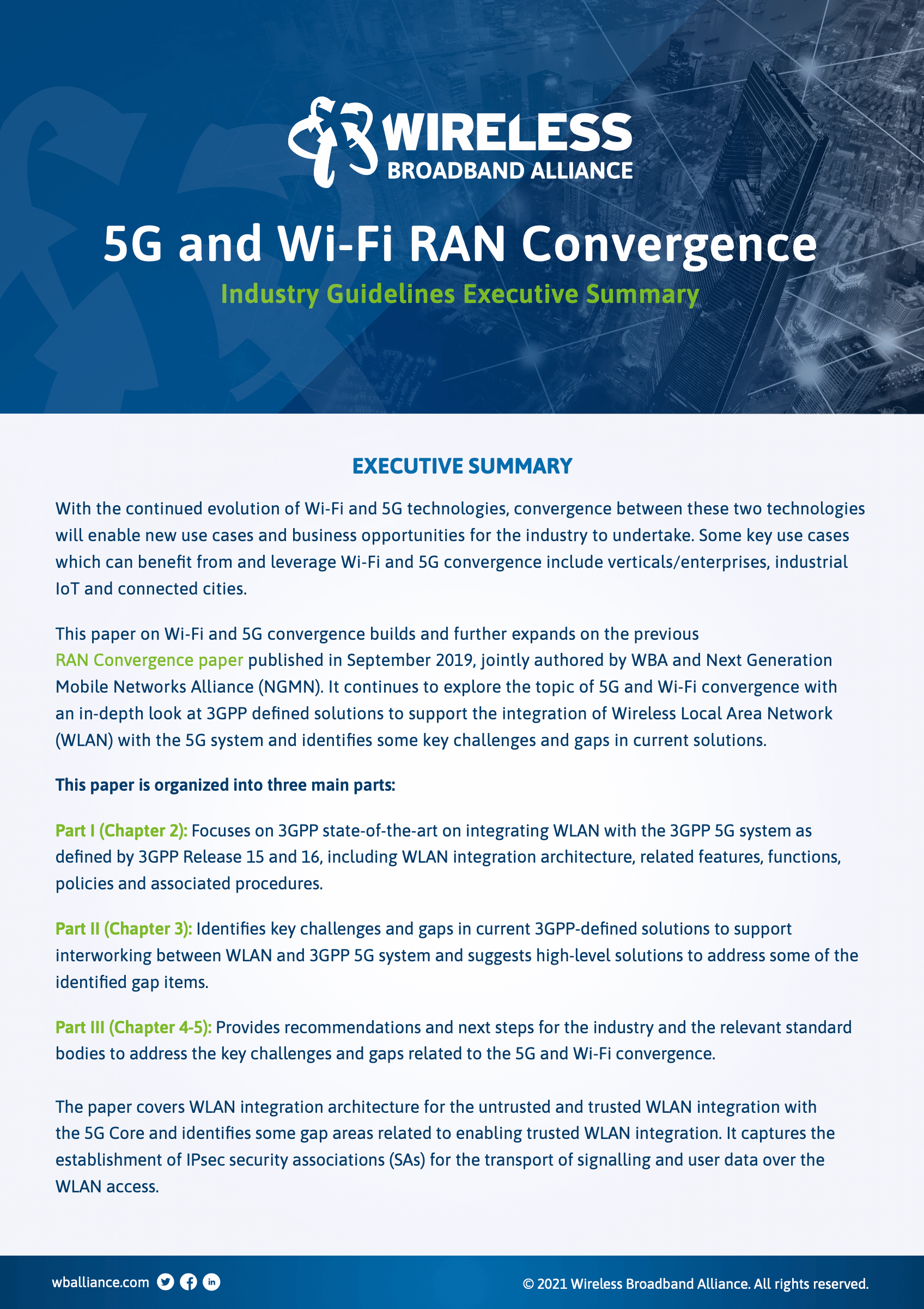
5G and Wi-Fi RAN Convergence Whitepaper – Executive Summary
Convergence between Wi-Fi and cellular access technologies is critical to the long-term success of 5G. That is according to WBA’s 5G and Wi-Fi RAN Convergence whitepaper, developed with input from mobile carriers, Wi-Fi providers, telecom manufacturers, and its own 5G Working Group.
The report is expanding on the WBA and NGMN RAN convergence whitepaper from 2019 which articulated the potential benefits and use-cases of Wi-Fi 6 and 5G convergence, provides a breakdown of the current standards and key business opportunities for operators with this technology.
Onboarding Evolution
Passpoint introduced seamless, automatic and secure authentication, initiating an important change from password-based networks to a disruptive experience, in which the end-user would simply be connected.
In an effort to support today’s data security trends and simplify roaming solutions, the move to WBA OpenRoamingTM has seen a noticeable increase over the last few months within the Wi-Fi industry. The latest achievement was the launch of WBA OpenRoaming, a global Wi-Fi roaming federation that enables a seamless and secure connection to Wi-Fi among a trusted network of roaming partners.
The whitepaper “Onboarding Evolution – User Engagement in WBA OpenRoaming™ Era” explains the difference between what happens on a network authentication and interconnection level, from the software layer that can be added on top of it. It examines how OpenRoaming and Captive Portal work together on different layers and at different stages of the Wi-Fi onboarding process.
WBA’s previous white paper, “Captive Network Portal Standards” defines some existing use cases, aligns user experience (UX), presents practices to consider and provides suggested guidelines for future features that can be adopted as a unified standard by client devices, client manufacturers and network hardware manufacturers.
Wi-Fi & LoRaWAN® trials
Wi-Fi & LoRaWAN ® Trials – An Overview of Use Cases Across Regions Combining Two Powerful Technologies, the latest joint white paper from the Wireless Broadband Alliance (WBA) and LoRa Alliance, illustrates that selecting an intelligent multi-radio strategy is becoming increasingly important to succeed in a connected world. This paper provides details on practical trials and proof of concept deployments (POCs), representing a variety of use cases implemented across different geographies and verticals. It concludes that hybrid Wi-Fi and LoRaWAN connectivity increases market opportunities and provides a strong ROI while offering enhanced network solutions.
This paper builds on the two organizations’ earlier work, “Wi-Fi & LoRaWAN Deployment Synergies: Expanding Addressable Use Cases for the Internet of Things,” which compared the two technologies theoretically and sought to demonstrate how they could be utilized to effectively support a vast array of use cases.
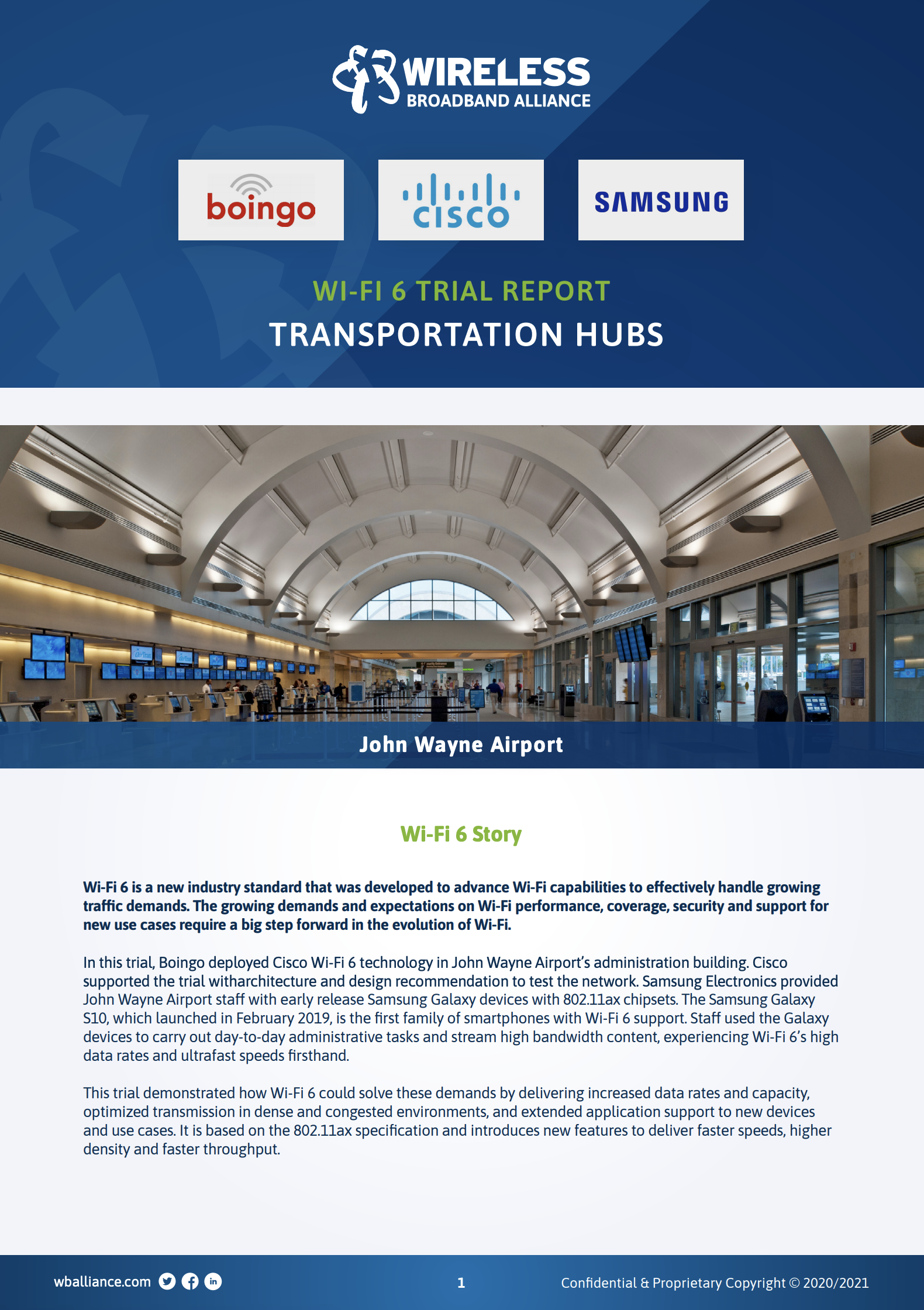
Wi-Fi 6 Trial Report – Transportation hubs
In the U.S, Boingo, Cisco and Samsung worked together to launch Wi-Fi 6 at John Wayne Airport (SNA) to power a next generation connectivity experience and support airport operations. Following the SNA deployment, Boingo has moved its Wi-Fi 6 technologies from trials to commercial operations and most recently, Boingo has announced an airport-wide commercial deployment of Wi-Fi 6 at São Paulo/Guarulhos International Airport (GRU), delivering incredibly fast speeds and low latency to passengers.
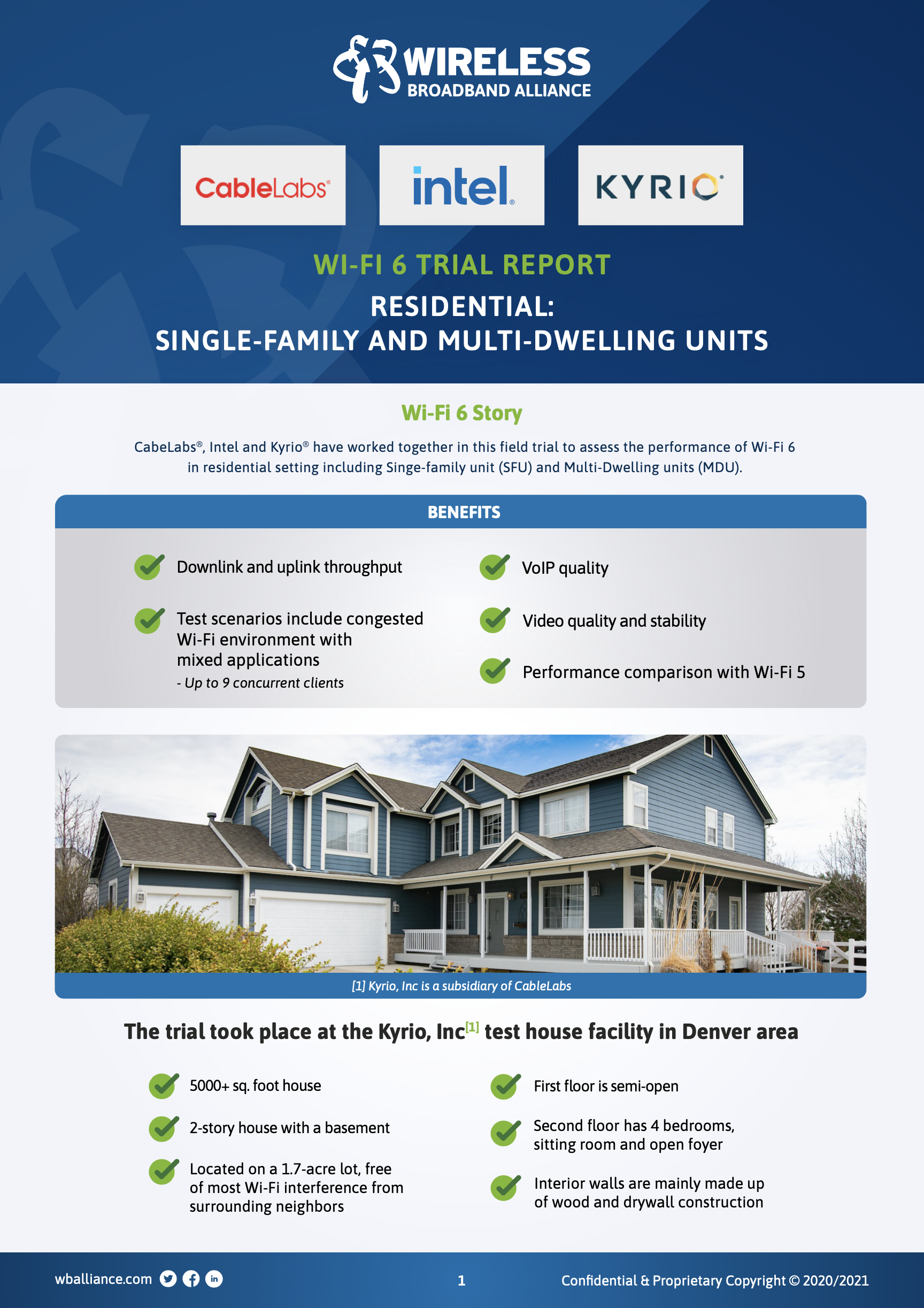
Wi-Fi 6 Trial Report – Single-family and multi-dwelling units
CableLabs®, Intel and Kyrio® deployed Wi-Fi 6 in a mixed-use residential area to increase the user experience in a Wi-Fi loaded In this trial, Wi-Fi 6 delivered a significant increase in throughput, enabling the delivery of multiple 4K video with higher quality.
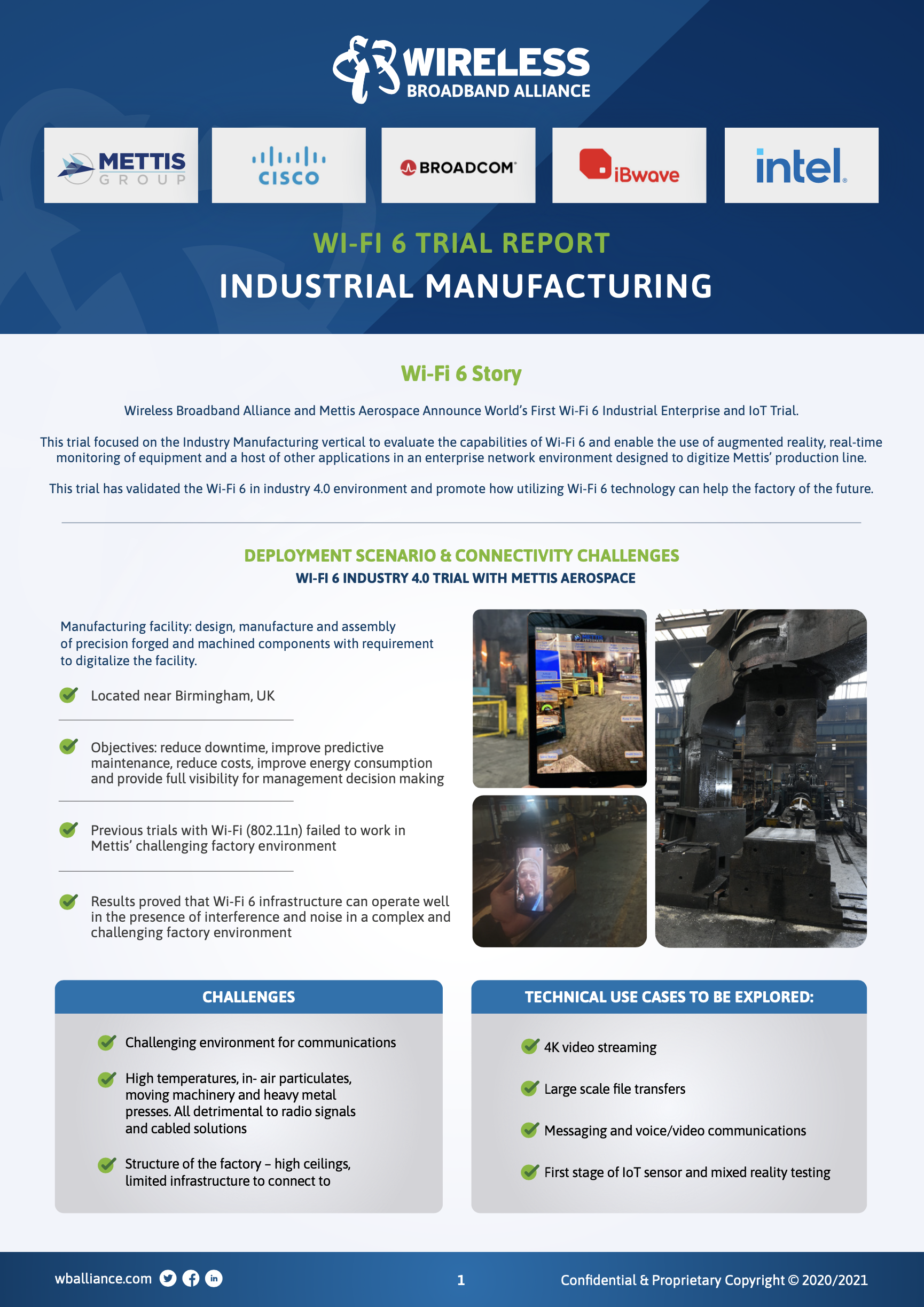
Wi-Fi 6 Trial Report – Industrial Manufacturing
Mettis Aerospace worked with Broadcom, Cisco, iBwave and Intel to deploy Wi-Fi 6 in a dense industrial environment with heavy metal, high temperatures and moving machinery, where previous generations of Wi-Fi did not perform well. The Wi-Fi 6 trial demonstrated much improved reliability, coverage, throughput and lower latency for supporting mission critical applications.