

This blog was written by Pedro Mouta, Senior Manager, Wireless Broadband Alliance.
2025 marked a major turning point for the Wi-Fi ecosystem. After years of discussion and incremental progress, a long-awaited capability became a reality: the ability for Identity Providers (IDPs) to receive and act on access network performance metrics from the moment a user’s device is attempting to connect to a Passpoint® network.
In 2026, that turning point has been validated through real-world deployments and production trials. For the first time, Wi-Fi can be evaluated, controlled, and trusted in real time, bringing it materially closer to the operational maturity long associated with cellular networks, and helping the IDP to trust much more Wi-Fi for offloading.
Access Network Metrics (ANM) represent a fundamental shift in how Wi-Fi quality is assessed and managed. IDPs can now use performance data at the moment of association to directly influence connection decisions, aligning Wi-Fi operations more closely with the expectations set by cellular networks.
The Long-Standing Challenge: Scale Without Visibility
Wi-Fi hotspots have traditionally been deployed in a non-centralized way, scattered around the globe by millions of different providers. This, in turn, has always been a challenge for unified policy application – especially in guest, public and roaming scenarios.
Traditional roaming agreements by larger operators, for instance, were built on bilateral wholesale models between identity providers and access networks, granting operators partial control over their subscribers’ experience, however, these approaches did not scale globally and lacked real-time insight into access network performance.
Even with secure, automated onboarding technologies like Passpoint®, IDPs and operators often rely on roaming hubs for interconnection, financial settlement, and accountability, which can limit the end networks they work with, as they cannot fully control or trust that the Wi-Fi experience meets their standards.
OpenRoaming Solved Scale
WBA OpenRoaming™ fundamentally changed the economics and scalability of Wi-Fi roaming. By combining Passpoint with Dynamic Peer Discovery (DPD) and RadSec, OpenRoaming enabled a federated model that scales globally. In 2026, OpenRoaming support is widely integrated into access point and controller platforms, with major vendors offering native configuration and management capabilities.
Major equipment manufacturers now ship their APs and controllers with OpenRoaming-ready capabilities built into their GUIs -a milestone in usability and adoption.
However, as adoption accelerated, cautious IDPs consistently raised a key concern:
“How do I ensure my subscribers are not exposed to poor-quality Wi-Fi networks that I cannot see or control?”
This is precisely where Access Network Metrics (ANM) comes in.
What Is ANM ? Why It Matters Now?
Access Network Metrics (ANM) originated within the WBA three years ago, following three phases of definition, validation, and production trials, is now a deployable capability.
ANM defines a reference standard, aligned with ongoing IETF work as an Internet Draft, enabling the transmission of performance metrics through RADIUS using a specific attribute called Connect-Info.
In practice, this means that using existing, proven technology –not something 5–10 years away -network owners can now share real-time and historical performance metrics directly with Identity Providers (IDP).
The info transmitted itself is flexible -the network owner decides which to share -but the important point is that the pipeline now exists.
This creates a foundation for trust, transparency, and collaboration between access networks and IDPs, encouraging operators to lean more heavily on Wi-Fi -not just for its lower operational cost per bit and indoor coverage advantages, but because they now have real visibility and control over network quality at the moment of association.
What it means for an IDP or Operator
Thanks to ANM, an operator’s AAA server (Authentication, Authorization, and Accounting) can now automatically receive, via Passpoint/OpenRoaming, real-time network metrics when a user’s device attempts to connect.
The operator can then make an instant decision on whether to allow or reject that association, based on those live metrics.
If the data shows poor performance – for example, low RSSI -the IDP can reject the connection. As conditions improve and metrics rise above defined thresholds, the network can be accepted.
This effectively gives operators a real-time QoE gatekeeper and the ability to protect their users from bad Wi-Fi experiences before they happen.
From concept to demonstration – WBA ANM milestones
During the WBA Working Sessions in Paris on October 13, 2025, the ANM leadership team showcased the real-world implementation of this concept.
The work evolved through three distinct phases:
- Phase 1 (2023) – Defined scope and essential metrics; explained why Access Network Metrics are needed (Download the Phase 1 report HERE)
- Phase 2 (2024) – Established RADIUS Connect-Info for metric delivery as the preferred mechanism for data exchange; Defined how the metrics should be structured and communicated (Download the Phase 2 report HERE)
- Phase 3 (2026) – Validated through large-scale production deployments and real-time decisioning, with live implementations demonstrating the extension of composite metrics and deeper data analysis. (Report is coming soon)



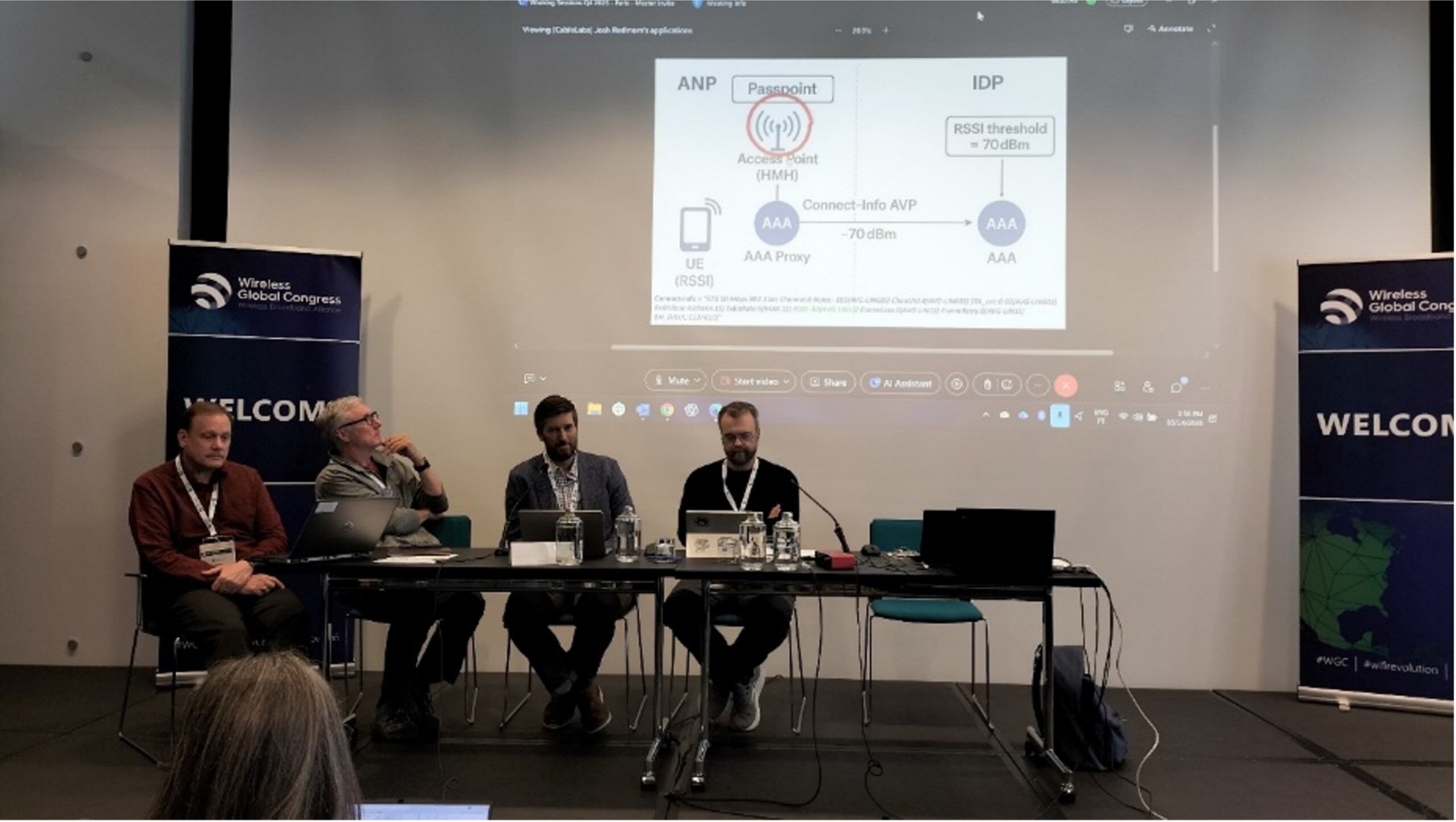
Figure 1 – From left to right: Mark Hamilton (Ruckus Networks), Stuart Strickland (HPE), Joey Padden (Helium) and Josh Redmore (CableLabs) – demonstrating the real time QoE decision making at WBA Members Working Session 2025.
Demonstration Overview
In the live demo, the network (ANM) used a AAA proxy to forward metrics to the IDP’s RADIUS server.
While the user device (UE) attempted to associate, the network continuously reported performance metrics, such as RSSI. The IDP, in real time, decided whether to allow or reject the connection based on those values.
Until the RSSI reached the defined minimum threshold, the operator rejected the association. Once the metric improved, the device was accepted.
The team is already working on removing the need for a local AAA proxy by standardizing support directly into HostAPD or AP firmware, allowing access points themselves to send metrics natively.
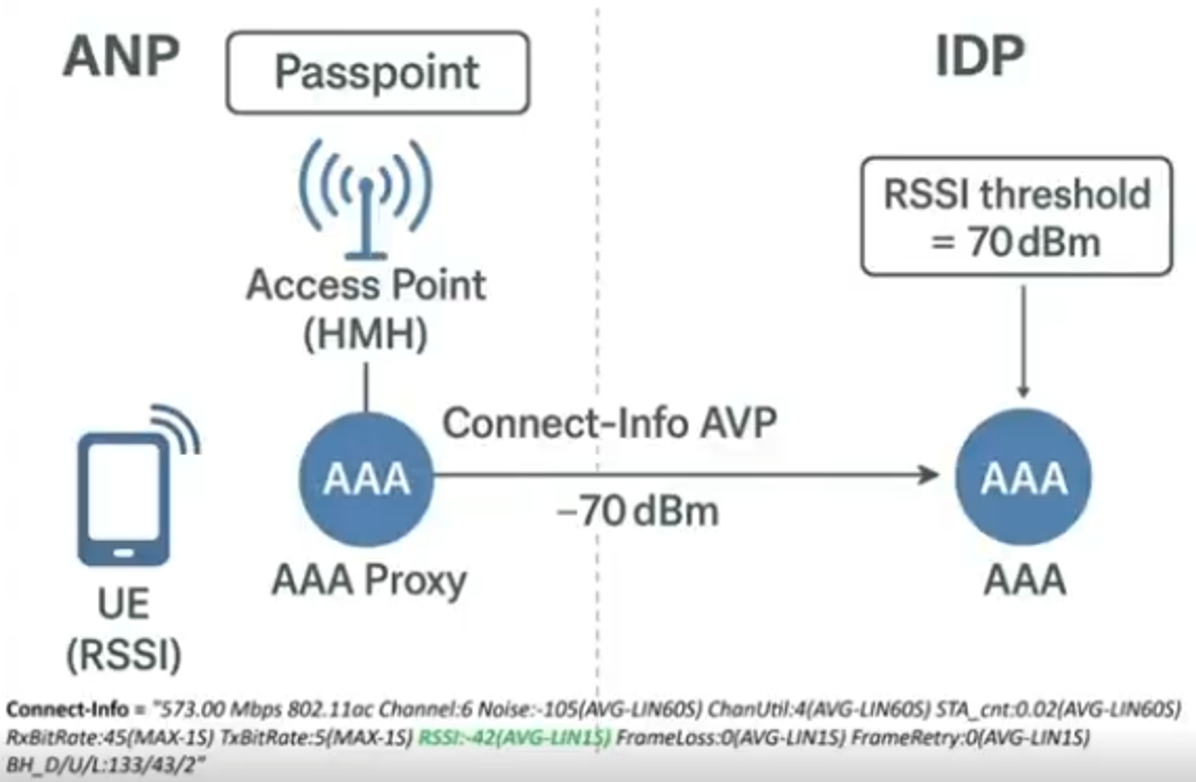
Figure 2 – QoE validation flow between the network and the IDP
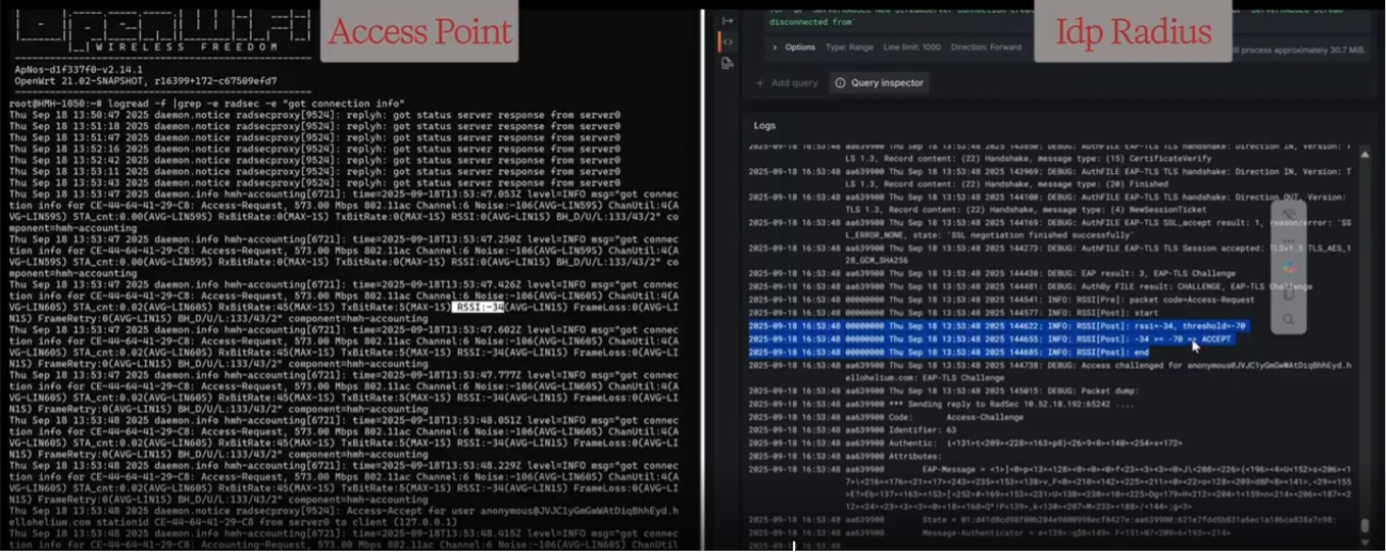
Figure 3 – Metrics communicated by the AP and decision taken by the IDP RADIUS
Considerations
| 1. The rejection behavior: Repeated rejections can increase signaling load and battery consumption as the UE retries. This is acknowledged, but prioritizes solving the higher-value challenge first, giving IDPs control over user experience quality. |
2. Impact on Wi-Fi adoption: Allowing operators to reject poor-quality Wi-Fi does not reduce adoption—it enables it, as trust drives usage. When operators can control and trust Wi-Fi quality, they are far more likely to integrate it as part of their overall connectivity strategy -leveraging Wi-Fi’s cost efficiency and coverage benefits with confidence. |
3. Market segments: ANM is particularly impactful in: • Wholesale/Managed Roaming – where operators already had some control through hubs and intermediaries. • Public & Guest Wi-Fi – historically unmanaged and unmonetized. |
|---|
ANM’s real-time decisioning capability gives IDPs, including operators, new confidence to participate in public and guest Wi-Fi ecosystems -accelerating OpenRoaming adoption and raising user experience globally.
Next Steps
Access Network Metrics is no longer a conceptual framework. It is a production-validated capability reshaping how Wi-Fi quality is managed.
Access Network Metrics empowers operators and IDPs to protect user experience, make smarter roaming decisions, and extend Wi-Fi’s role in global connectivity with confidence. It strengthens trust across the ecosystem and brings Wi-Fi closer to parity with cellular networks in terms of visibility and control.
Learn more about Access Network Metrics:
WBA continues to serve as the bridge between standards and real-world deployment, where collaboration transforms persistent industry challenges into operational progress.
Learn more about Access Network Metrics:
WBA continues to serve as the bridge between standards and real-world deployment, where collaboration transforms persistent industry challenges into operational progress.
Interested in joining the coming projects?
For more information on Access Network Metrics program, please visit our website and get in touch if you would like to get involved.